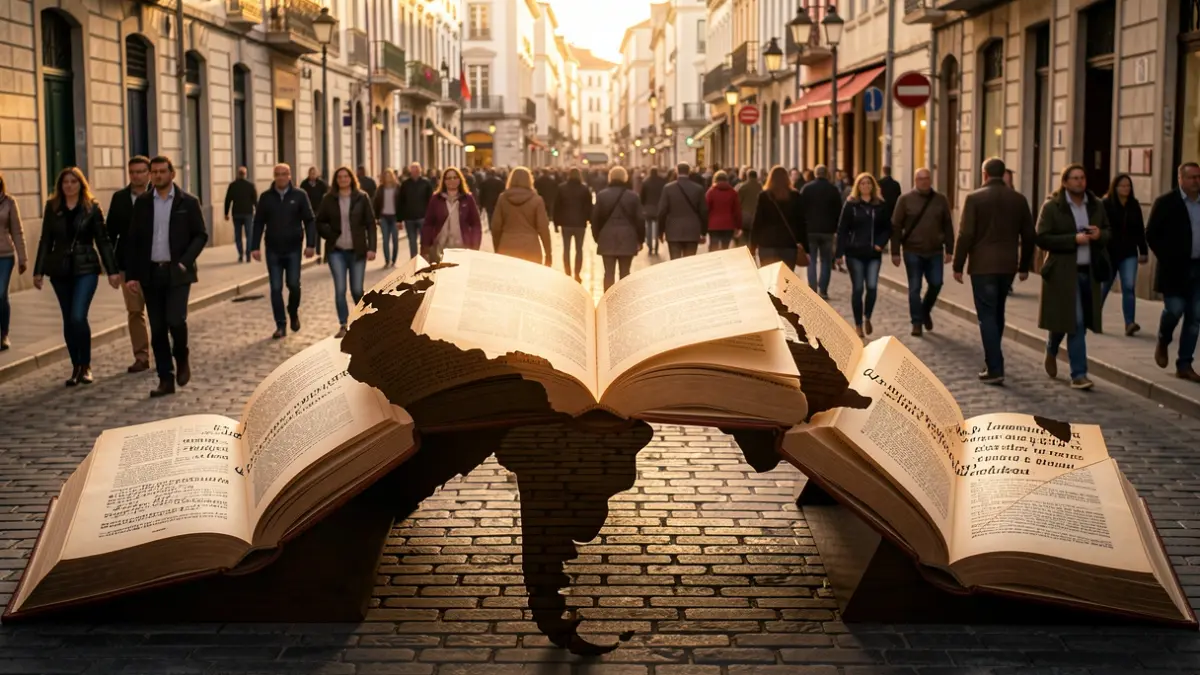
Poetry, proclaimed by UNESCO every March 21st, transcends aesthetics to become memory, resistance, and the search for common ground. In the Ibero-American sphere, it has historically functioned as a transatlantic link, a constant flow of influences, exiles, and affinities that have forged an intertwined poetic heritage.
The 19th century saw Spanish poetry evolve from romanticism towards more refined forms. The figure of Gustavo Adolfo Bécquer and his Rimas (1871) marked a milestone with their emotion-centered lyricism, establishing a common foundation, albeit with expressive limitations.
It was the Nicaraguan poet Rubén Darío who, from Latin America, led the great transformation of modernism with his work Azul... (1888). This aesthetic renewal, characterized by musicality and formal experimentation, decisively influenced Spain, where authors like Juan Ramón Jiménez and Antonio Machado incorporated it, connecting the cultural crisis of the Generation of '98 with Latin American avant-garde movements.
In the early 20th century, the Chilean creationism of Vicente Huidobro proposed that the poem should create its own reality, breaking syntax and referentiality. This idea germinated in Madrid with ultraism, conceived in the Café Colonial, which sought maximum intensity with minimal elements, using surprising metaphors and visual structures.
The Argentine Jorge Luis Borges, a participant in Spanish ultraism, introduced these currents to Latin America upon his return to Buenos Aires, highlighting the constant exchange between both shores.
The Spanish Generation of '27 and Latin American neobaroque, with figures such as Federico García Lorca, Concha Méndez, José Lezama Lima, and Severo Sarduy, revived the baroque heritage. While the Generation of '27 combined tradition and experimentation, neobaroque radicalized language from a postcolonial perspective, questioning a homogeneous concept of Hispanity.
20th-century poetic networks fostered constant exchange between cities like Madrid, Buenos Aires, and New York. Lorca captured these experiences in Poet in New York (1940), and Pablo Neruda, from Madrid, forged close ties with Rafael Alberti and Luis Cernuda. The II International Congress of Writers for the Defense of Culture in 1937 brought together figures like César Vallejo, Octavio Paz, and Antonio Machado, symbolizing the peak of transatlantic dialogue.
20th-century dictatorships prompted displacements that impacted poetry. Figures like León Felipe wrote from Mexico, and Cristina Peri Rossi from Barcelona.
The Latin American boom of the 1960s and 70s solidified the region's global standing. The professionalization of the publishing market by agents like Carmen Balcells and publishers such as Seix Barral and Sudamericana facilitated the circulation of Latin American authors in Europe.
In the 20th century, poetry transcended the written text. Peruvian poet Victoria Santa Cruz placed poetry in the body and voice with her emblematic poem Me gritaron negra (1978), while in Spain, Camarón de la Isla reinterpreted a poem by Federico García Lorca in La leyenda del tiempo (1979), merging poetry and music.
Poetry is an open conversation that spans generations and geographies. As Octavio Paz wrote, it is 'knowledge, salvation, power, abandonment,' and a bridge that continues to be built between Latin America and Spain.