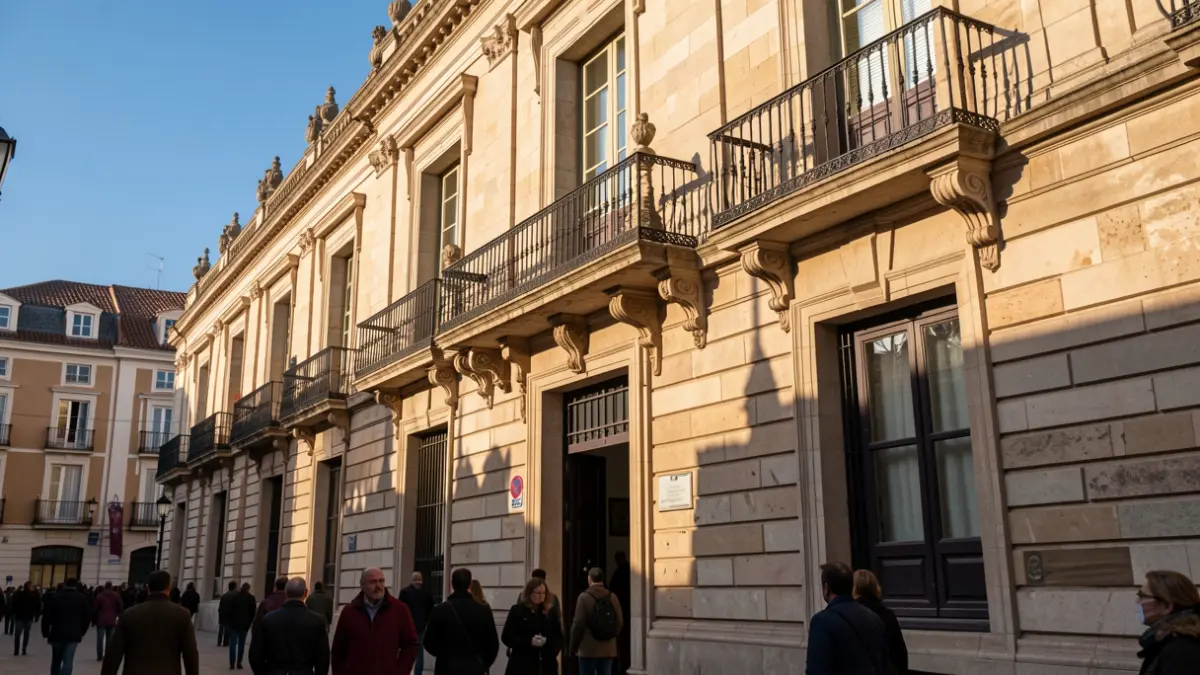
A new political tension point has ignited at the Madrid City Hall. The President of the Plenary, Borja Fanjul, has approved a resolution modifying citizen access conditions to the Commissions Room in the Plaza de la Villa. Although the regulation maintains a total capacity of 16 seats, it introduces a fixed distribution system limiting general public access to only six seats, assigning the remaining ten to invitations controlled by the political parties themselves.
The measure has provoked widespread indignation from the left in the Palacio de Cibeles, which denounces a deliberate attempt to weaken citizen oversight. The resolution, signed this week, marks a shift from the regulation that governed these rooms since January 21, 2020. Under the new parliamentary guidelines, the seat distribution is as follows: General public: 6 seats; Popular Municipal Group (PP): 5 invitations; Más Madrid: 2 invitations; Socialist Municipal Group (PSOE): 2 invitations; Vox: 1 invitation. The allocation for parties respects the numerical proportionality from the last municipal elections.
For the spokesperson of the Socialist Municipal Group, Reyes Maroto, this remodeling of the institutional space represents a "new affront to democracy" orchestrated by the administration of Mayor José Luis Martínez-Almeida. Maroto has described the strategy as "gagging policy" against citizen participation and warned that the measure will have a strong "response at the ballot box".
Meanwhile, the spokesperson for Más Madrid, Rita Maestre, has significantly escalated the criticism, directly addressing the role of the Plenary President. Maestre stated she sees Borja Fanjul as "a nightclub bouncer" who "restricts" access to the Commissions Room of the Plaza de la Villa, "the home of all Madrileños," interpreting this move as an aversion by the mayor to diversity and Madrid's associative fabric.
In contrast to the opposition's complaints, the Popular Municipal Group defended the measure through its spokesperson, Carlos Izquierdo, who vehemently denied any censorship. The PP representative clarified that the capacity of the Commissions Room has not changed and that Borja Fanjul's intention was simply to "transparently organize" attendance, calling the PSOE's assessments "unfortunate".
Furthermore, the Popular spokesperson took the opportunity to launch a strong attack against the socialist spokesperson, questioning the standards of "democracy within the PSOE" and urging Reyes Maroto to reflect on her party's internal situation.