
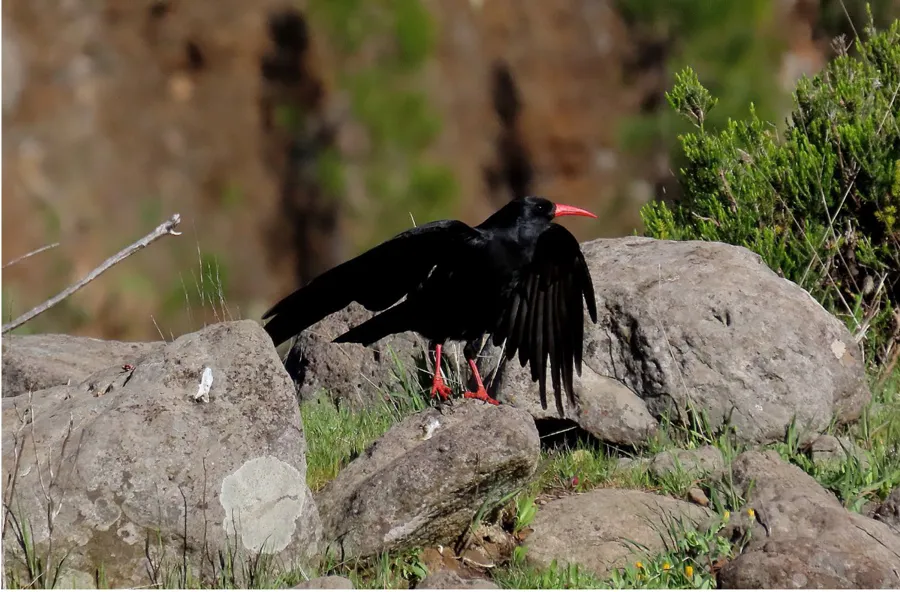
The study, published in the scientific journal PeerJ, analyzes mitochondrial and nuclear DNA from specimens across sixteen countries in Europe, Africa, and Asia. The findings indicate that the Himalayan region and the Tibetan plateau are the geographical origin from which both species diversified, adapting to open environments and rocky cliffs.
During the Pleistocene, these birds began their westward dispersal through the Levantine corridor, the Nile Valley, the Atlas Mountains, and the western Mediterranean. The Mediterranean basin acted as a refuge during the most severe glacial periods, allowing the survival of populations that today maintain high genetic variability, including lineages in the Canary Islands.
The research highlights the choughs' high adaptability to different habitats and climatic conditions. Genetic data suggest the existence of now-extinct populations that connected the Iberian Peninsula with the Canary Islands, currently found only on the island of La Palma.
The collected information is particularly relevant for the conservation of isolated and declining populations, such as those in La Palma or the Ethiopian highlands. Preserving these genetically distinct lineages is key to maintaining the species' evolutionary diversity long-term and preventing the homogenization of genetic heritage.
The study emphasizes the importance of knowing the exact origin and evolutionary affiliation of specimens for conservation programs like captive breeding or reintroduction, as mixing lineages without rigorous criteria can lead to the loss of local adaptations.