The planet's geological memory is older than previously thought, according to research published in Earth and Planetary Science Letters. The study focuses on magmatic rocks formed between the Late Carboniferous and Mid-Permian periods (305 to 250 million years ago), demonstrating their reliability for interpreting processes occurring tens of kilometers deep. This collaborative work between Spanish and Chinese teams is significant for understanding mineral resource distribution and continental region behavior.
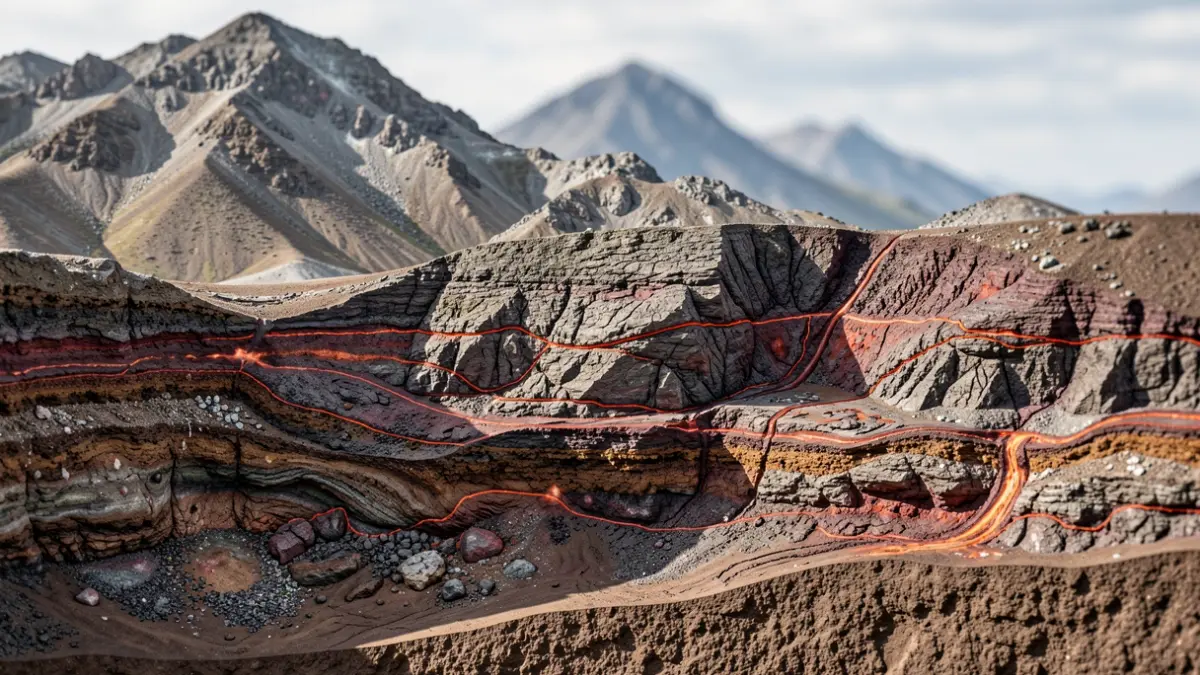
The research uniquely integrates isotopic geochemical mapping, geophysical observations, and large-scale thermodynamic modeling. It utilizes thousands of geochemical anomaly measurements recorded over decades in the Tianshan mountain range, straddling the border between China and Kyrgyzstan. The findings confirm that the magmas forming the range are predominantly granites and that magmatic processes from over 250 million years ago continue to control the deep structure of the present-day lithosphere.
“"The current lithosphere is not an instantaneous snapshot but the accumulated result of geological processes that developed over hundreds of millions of years. Our results demonstrate that Late Paleozoic magmatism left a clear and quantifiable imprint on the deep lithospheric structure that we can still detect today."
By spatially analyzing isotopes of elements such as hafnium and neodymium, the team identified two distinct lithospheric domains under the Western Tianshan. One to the north, linked to magmas derived from a mantle modified by the subduction of an oceanic plate; and another to the south, enriched by recycled sediments from an ancient continental crust. These geochemical differences were detected through gravity and seismic wave velocity anomalies in the lower crust, at depths between 35 and 45 km.
Thermodynamic phase equilibrium models simulated magma differentiation, confirming that the two domains generated distinct mineral residues. The southern domain resulted in a less dense lower crust with minerals like plagioclase, while the northern domain retains a denser lower crust with minerals such as clinopyroxene or garnet. These differences naturally explain the contrasts observed in current seismic and gravimetric data, influencing lithospheric density and seismic wave velocity.
The work demonstrates the possibility of reconstructing the deep architecture of very ancient orogens, even without direct fragments of the deep crust, by utilizing surface-exposed magmatic rocks. The research is crucial for interpreting resource distribution and the behavior of continental plates.