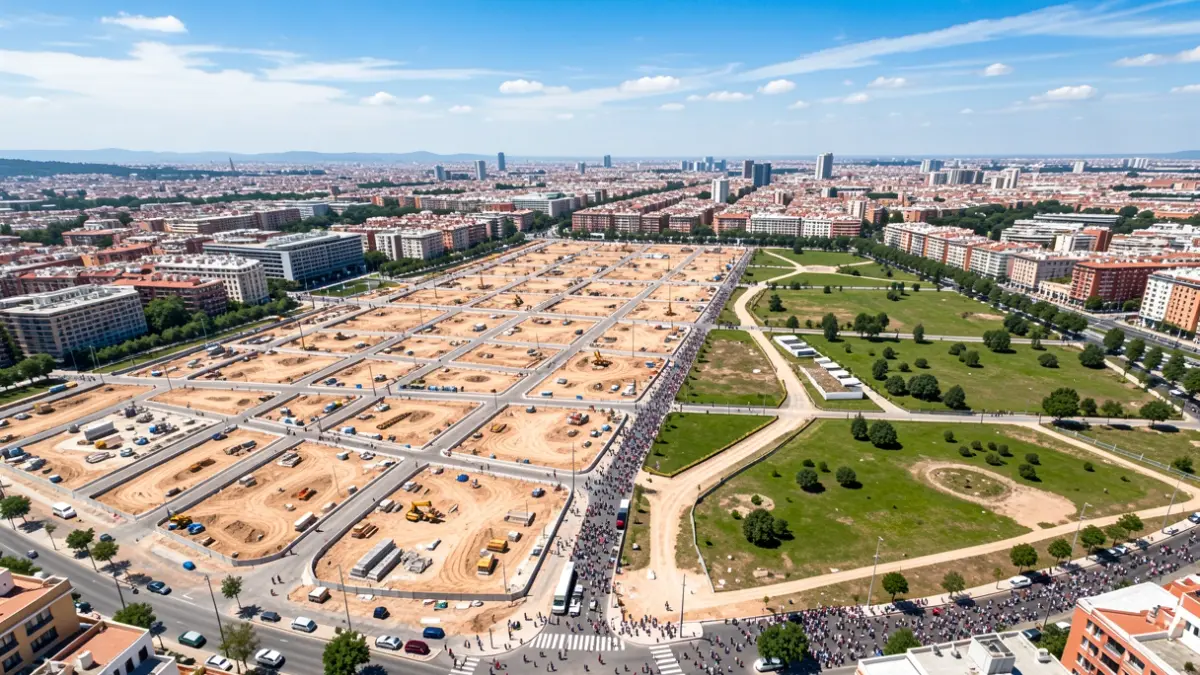
The Governing Board of the Madrid City Council has definitively approved this Thursday the urbanization project for the Campamento operation, located in the Latina district. This urban development covers more than 2 million square meters and plans for the construction of 10,700 homes, of which up to 65% will have some form of public protection.
Deputy Mayor, Inma Sanz, announced the approval following the Mayor, José Luis Martínez-Almeida's, prior statement about the "definitive unblocking" of the operation. The project, promoted by Casa 47 Public Business Entity and supervised by the City Council's Area of Works and Equipment, will involve an investment exceeding 383 million euros.
Sanz highlighted the "great news" this step represents after "so many years" of waiting and emphasized the Council's "extraordinary effort" to expedite housing construction. The City Council will ensure compliance with planned green spaces, roads, and facilities, and has urged the developer, Casa 47, to give the project top priority.
The area, situated along the Paseo de Extremadura between the avenues of los Poblados and de la Aviación, will help connect the western part of Madrid with nearby municipalities such as Pozuelo de Alarcón and Alcorcón. Of the 10,700 planned homes, approximately 7,000 will have public protection: 3,800 for Limited Price Publicly Protected Housing, 2,100 for Basic Publicly Protected Housing, and 1,100 for rental. The remaining 3,700 will be free-market housing.
The project also reserves building capacity for commerce (93,340 m²) and offices (59,048 m²). The area designated for public networks is 1,563,420 m², including internal roads (560,980 m²), tree-lined public spaces (210,872 m²), social facilities (180,904 m²), green zones (154,169 m²), and public endowment uses (147,719 m²).
Twenty-two green zones will be created, notably the established Pine Forest of the Military Sports Center of La Dehesa and the northwestern park. The planting of 8,000 trees is planned. The facilities of the Army Geographic Service and the Military Veterinary Center will be maintained as public endowments.
The urbanization will be executed in three phases. Phases 1 and 2, south of the area, can be undertaken independently or jointly. Phase 3, contingent on the tunneling of the A-5 highway through the area, will require the project design for said infrastructure. Sanz considers it "premature" to set deadlines for this last phase but argues that the division will allow progress "as quickly as possible" with the first two.
The urban modification promoted by the City Council allows for the simultaneous execution of urbanization and construction phases to shorten timelines. Sanz urged the Spanish Government to act "with all haste" to make the project a reality, noting that the next steps now fall to Casa 47 and the Ministry.