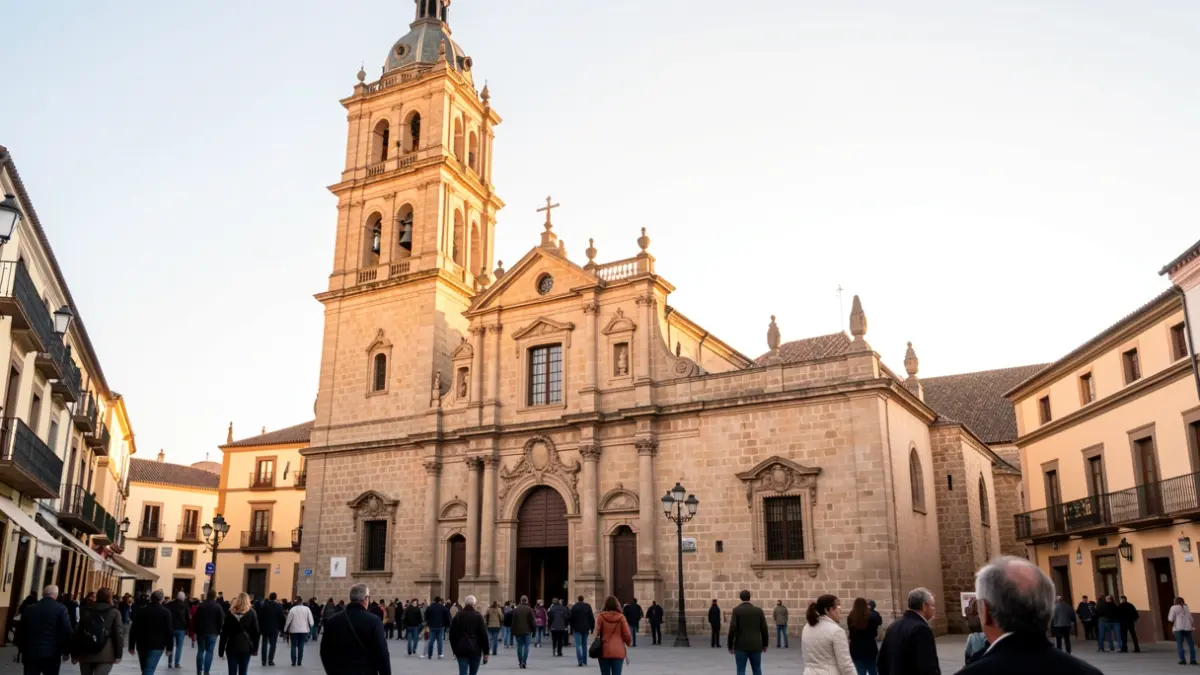
The parish church of Santiago and San Juan Bautista, a 19th-century temple with deep Jacobean ties and the starting point of the Camino de Santiago in Madrid since 1997, has been declared a Site of Cultural Interest (BIC) in the Monument category by the Governing Council of the Community of Madrid. The construction, designed by architect Juan Antonio Cuervo, replaced two ancient medieval churches and is a significant Christian place of worship in the capital.
The temple is notable for its facade, inspired by Spanish architecture, and its Greek cross plan. Its bell tower houses bells from former medieval churches, such as San Juan Bautista and Santiago, as well as a bell from Chinchón. The parish archive, meanwhile, preserves baptism, marriage, and death records from several churches.
Currently, the parish houses a valuable collection of movable assets of great artistic merit, many predating the current building and originating from the disappeared medieval churches. Among the most notable works are the canvases Santiago on horseback at the Battle of Clavijo, by Francisco Rizi (1657), and Baptism of Jesus, by Juan Carreño de Miranda (1682).
The sculptural collection includes carvings such as the Blessed Mariana de Jesús, by Julián de San Martín, and St. John the Baptist with the Lamb at his feet, attributed to Pedro Roldán or his daughter Luisa Roldán (La Roldana), from the second half of the 17th century. Additionally, an 18th-century organ, originally from the church of San Juan, has been preserved and adapted to the current space.