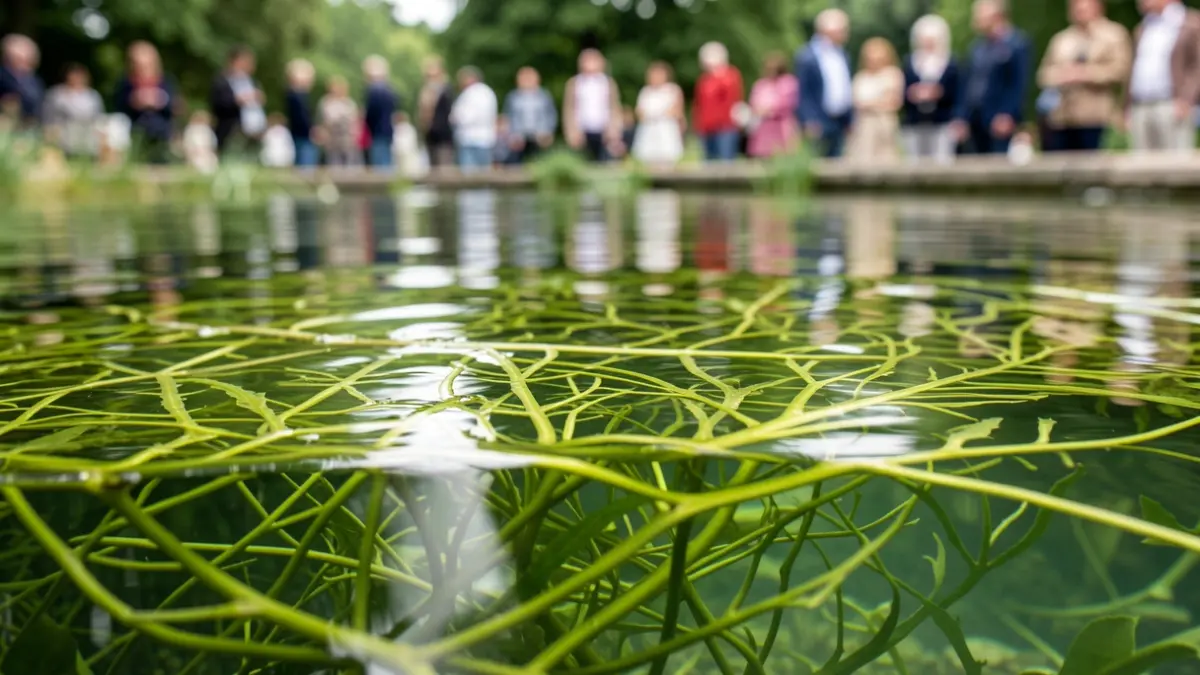
The actions of the Madrid City Council to restore urban biodiversity have yielded a significant scientific result: the detection of charophyte algae of the genus Chara in a naturalized pond on Vía Lusitana, Carabanchel. This discovery is remarkable for its rarity and high ecological value.
The appearance of these algae, previously mainly associated with calcareous wetlands in the region's southeast, expands the known distribution area of the genus and confirms the capacity of urban wetlands to recover biological communities. Charophytes are indicators of clean and transparent waters, as they are sensitive to pollution and nutrient enrichment.
Their presence in the Vía Lusitana wetland demonstrates the positive impact of municipal actions for biodiversity, showing that urban spaces can become high ecological value ecosystems when designed and maintained with environmental criteria.
The discovery occurred during monitoring visits by municipal agents of the micro-reserve network. Submerged meadows characteristic of the Chara genus were identified, growing in clean, transparent waters, possibly corresponding to species like Chara vulgaris or Chara hispida.
Besides indicating water quality, charophytes play a vital ecological role by oxygenating aquatic environments, stabilizing sediments, limiting filamentous algae growth, and providing refuge for invertebrates and amphibians, thus contributing to ecosystem balance.
This finding is part of the Biodiversity Promotion and Management Plan by the City Council, initiated in 2022. The plan has involved an investment of 2.1 million euros, with 49 actions that have incorporated 1,147 new trees and over 11,400 shrubs, enhancing ecological connectivity.
The strategy is complemented by green infrastructure elements such as butterfly houses, nest boxes, insect hotels, ponds, and dry stone walls, all aimed at fostering urban biodiversity.