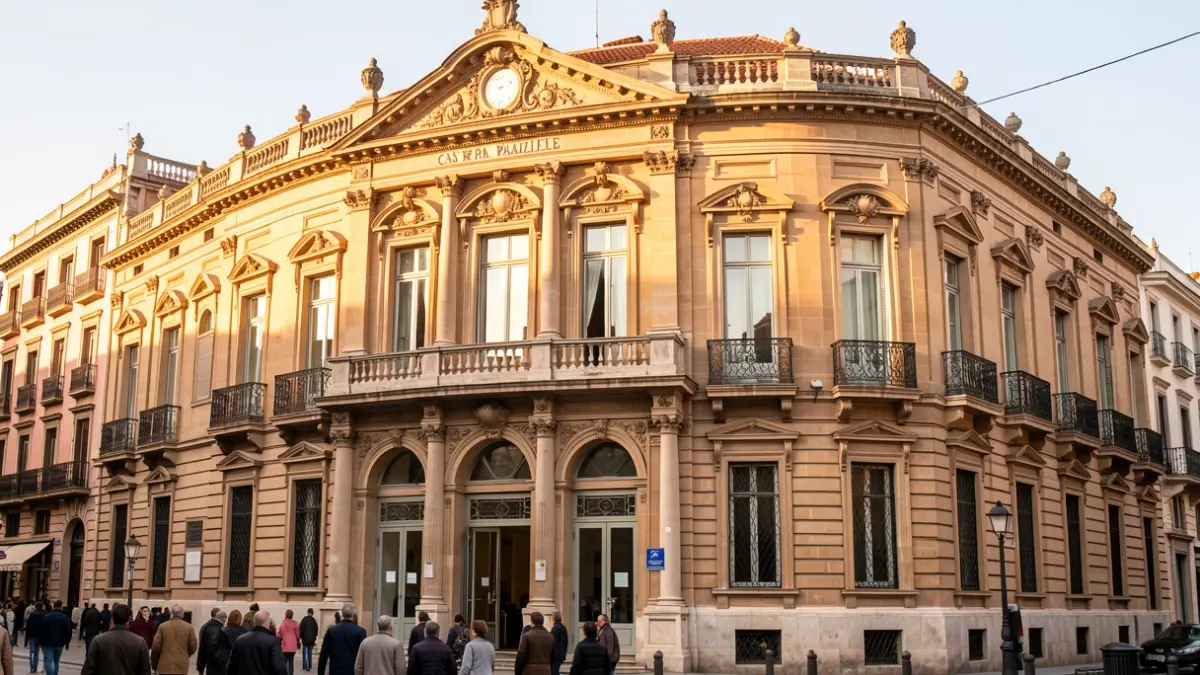
The Madrid City Council Plenary has given the green light, with the PP voting in favor, to a project that will allow the opening of another five-star hotel in the capital's center. The initiative will transform the historic and protected Casa Palazuelo, a building designed by Antonio Palacios between Calle Mayor and Calle Arenal. The opposition, comprising the PSOE and Más Madrid, voted against, while Vox abstained.
Left-wing groups criticized the decision, denouncing the continuous hotelization of central Madrid promoted by the municipal government. They pointed out that Casa Palazuelo, declared an Asset of Cultural Interest (BIC), still retained its original use as offices, and lamented that the objections presented by the PSOE, which questioned the plan's motivation and the justification for works on a unique building, were dismissed.
Socialist councilor Antonio Giraldo highlighted the building's importance and criticized that the municipal plan attributes some degradation to the presence of "low-quality commercial premises," while the change of use to a luxury hotel will force the closure of the current business center.
For his part, Más Madrid councilor José Luis Nieto Bueno warned of a "constant drip" of special plans transforming unique buildings into luxury hotels, irreversibly altering the city's identity. He cited examples such as the Edificio Metrópolis, Gran Vía 52, and the area around Canalejas.
The Urban Planning delegate, Borja Carabante, defended the building's architectural protection and assured that the change of use would be a modification of the existing tertiary use, maintaining commercial space on the ground floor. He also criticized the left for having granted hotel licenses during the previous term.
The urban development operation foresees the opening of a five-star hotel with 76 rooms, multiplying the owner company's annual revenue by ten. Projected revenues amount to 14.6 million euros annually, compared to the current 1.5 million from office rentals.
The building, known as Casa Palazuelo after the businessman who commissioned its construction by Antonio Palacios, was conceived to house shops, offices, and studios. It was declared an Asset of Cultural Interest in 1997 and has functioned as a business center for over a century. The project includes its integral conservation.