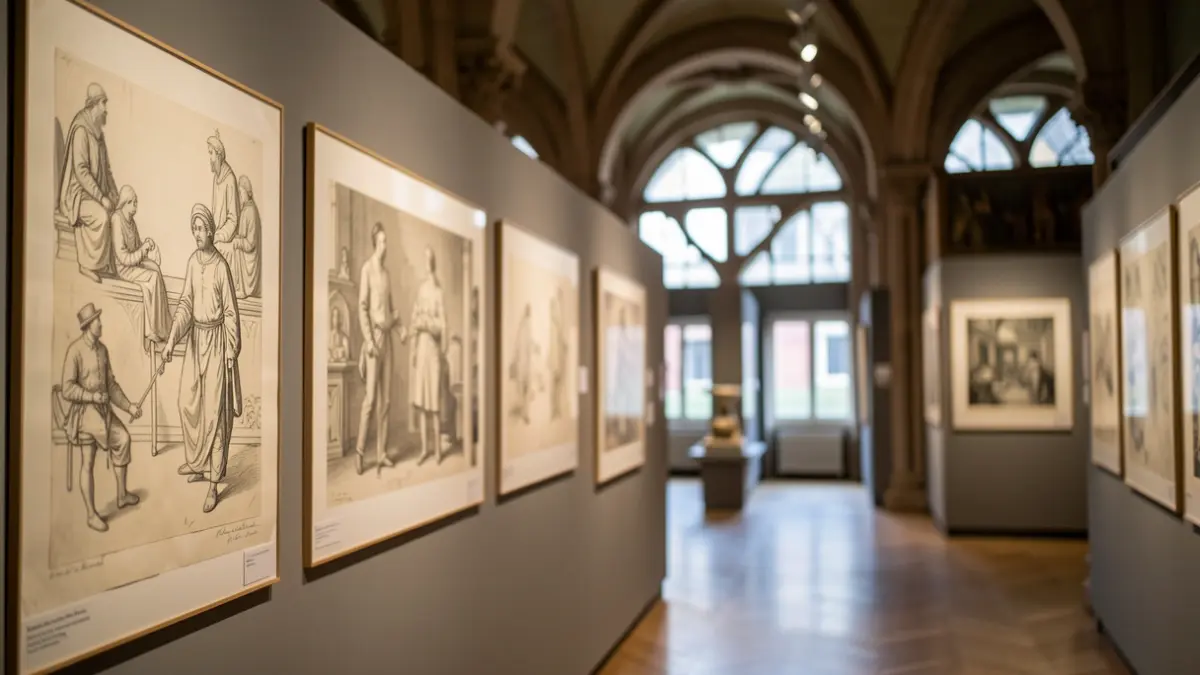
The exhibition, open until September 20th, focuses on the formative trips European artists undertook in Italy during the mid-19th century. For the first time, seventeen unseen drawings by Federico and Luis de Madrazo and Vicente Palmaroli, created before the founding of the Spanish Academy in Rome, are on display.
These works, largely recent acquisitions by the Ministry of Culture for the institution, come from the museum's own collection. Throughout the 19th century, artists like the Madrazos and Palmaroli sought inspiration in Rome, drawing from the creations of masters such as Michelangelo, Raphael, or Giotto, as well as from ancient ruins.
Beyond classical artistic inspiration, creators of the era paid considerable attention to popular types depicted in prints of the time, making them central figures in their artworks. Art students had access to drawing academies where they found live models in traditional attire. They could also sketch peasant women who came to Rome to sell their goods and who posed for a fee, particularly around the Piazza di Spagna.
“"The painter, sculptor, and engraver must necessarily frequent certain private schools at night for nudes, drapery, and costumes, where they are admitted upon payment of a conventional fee."
This quote is from the work 'The Artist in Italy and other countries of Europe. Current state of the Fine Arts', published in 1851 by José Galofre, which lends its name to the exhibition. Galofre also emphasized the importance of natural light for color study, warning that painting at night could lead to "falsehood in tones and heaviness in chiaroscuro" due to artificial light.