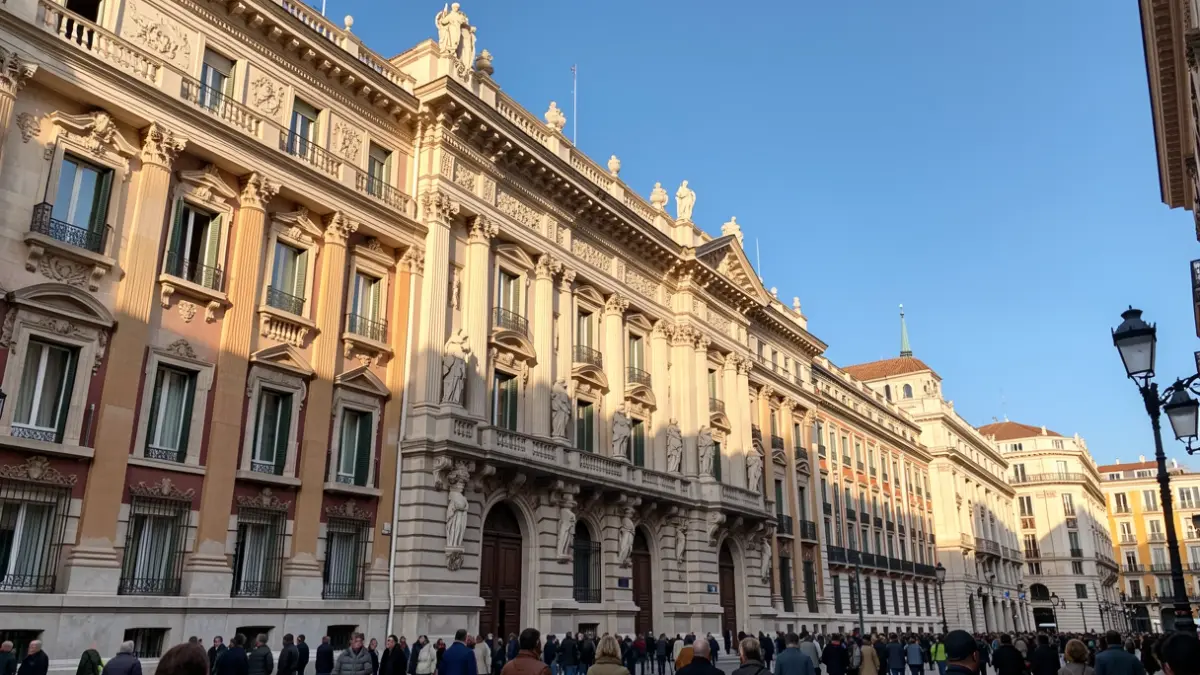
The regional government has opened the file to protect this architectural complex, recognizing its historical, architectural, and cultural values that narrate the evolution of the Spanish press from the late 19th century to the early 20th decades.
Although currently part of the ABC Serrano shopping center, the complex retains original elements that evoke its industrial and editorial past, despite adaptations for new uses.
The building's origins date back to 1896, with architect José López Sallaberry's project for the headquarters of the illustrated magazine Blanco y Negro, founded by Torcuato Luca de Tena y Álvarez Ossorio. The publication pioneered the use of color and coated paper, featuring contributions from figures like Emilia Pardo Bazán, Azorín, and Antonio Mingote.
The later arrival of the newspaper ABC, founded in these same facilities in 1903, further enhanced the building's significance. The newspaper transitioned from a weekly to a daily, necessitating successive expansions to house machinery and offices, such as the large printing hall designed by Francisco de Paula del Villar Carmona.
The file highlights the confluence of diverse architectural styles: a Neo-Plateresque language on the main facade of Serrano street, elements of Sevillian regionalism and Neo-Mudéjar in the expansion towards Castellana avenue (designed by Aníbal González and directed by Teodoro de Anasagasti), and features of the Chicago School and Art Deco in the 1920s expansion.
The protection extends to interior elements such as decorative ceramics by Daniel Zuloaga and the Hermanos Mensaque, stained glass by Maumejean, ornamental ironwork, the main staircase, the original lobby, and murals by José Arija. The Castellana facade includes an iconographic repertoire on printing and the company, with references to ABC and Blanco y Negro, and medallions featuring effigies of Johannes Gutenberg and Alois Senefelder.
After ABC's departure in 1989, the complex was converted into the ABC Serrano shopping center, inaugurated in 1995. The Community considers current uses compatible with the building's preservation, provided its heritage values are respected.
The declaration as BIC will require any future intervention to obtain authorization from the General Directorate of Cultural Heritage and the Office of the Spaniard, ensuring the preservation of this representative ensemble of Madrid's press history.