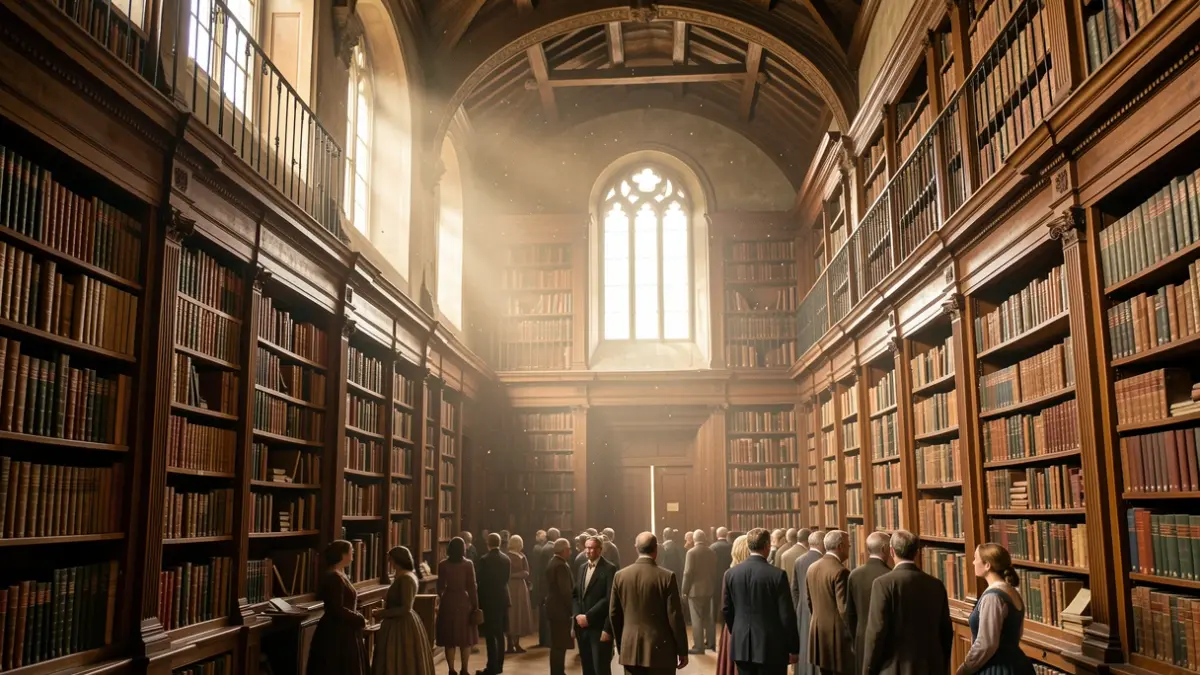
Last September marked 20 years since the agreement was signed between the Complutense University and Google for the digitization of the Complutense University Library (BUC)'s heritage. The project has enabled the digitization of 148,000 works from the Complutense catalog not subject to copyright. The BUC organized a commemorative event on October 22nd at the Faculty of Law, coinciding with International Open Access Week. Current director Antonio Moreno highlighted that the agreement's greatest legacy has been making hard-to-access works, many from the UCM's old collection, available to anyone, anywhere in the world.
The UCM was the first non-Anglo-Saxon library to join Google Books. The then director of the BUC, José Antonio Magán, recalled the pride of seeing the university's crest alongside those of Oxford, Harvard, Stanford, Michigan, and the New York Public Library. Google Books, launched in 2004, offered an opportunity to democratize and make thousands of works accessible, allowing Complutense to take an "exponential leap," according to then Head of Innovation Eugenio Tardón. Twenty years ago, only 20 percent of the library's old collection was cataloged, and general access was through VT terminals requiring MSDOS commands, or paper card catalogs.
Before Google, the UCM was already the Spanish university with the largest digitized collection thanks to the Dioscórides project (started in 1995), which digitized around 3,000 works. José Antonio Magán calculated that at Dioscórides' pace, it would have taken 400 years to scan what was done in three years with Google. The agreement also allowed for updating the catalog and the conservation status of the works. According to data from the former BUC director, the Complutense collections on Google Books receive over 105 million "full view" visits every six months, compared to an average of 7 or 8 daily consultations before digitization.
The event on October 22nd featured the Vice-Rector for Research and Transfer, Lucía de Juan; the director of the BUC, Antonio Moreno; and Lindsi Everett, representing Google Books. Everett expressed satisfaction with the ongoing agreement, which has enabled Google to digitize over 40 million books and gain firsthand insight into the essential work of librarians.
Antonio Moreno stated that the event also aims to recognize the contributions of those involved in the project's early years, including librarians, central services staff, management, and IT professionals. Vice-Rector Lucía de Juan emphasized that this agreement opened the BUC to the world and explains why it holds the largest digital collection among Spanish university libraries.