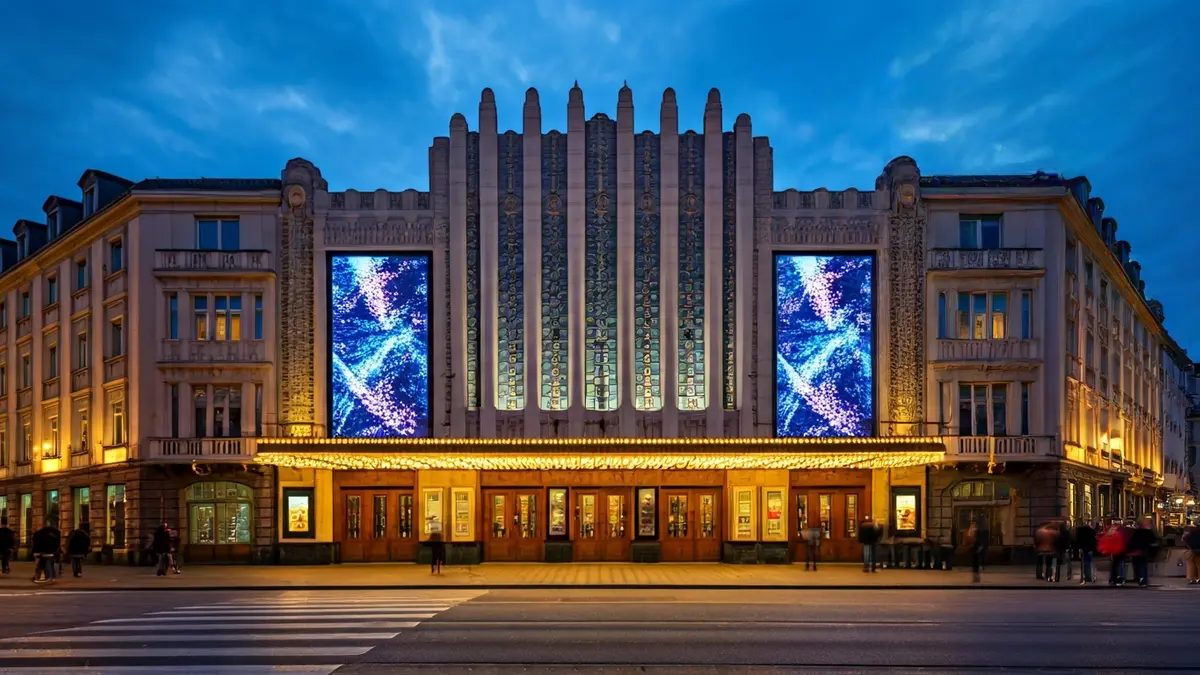
Inaugurated on December 11, 1926, with the screening of the silent film Luis Candelas, el bandido de Madrid, the building was designed by architect Luis Gutiérrez Soto. From its beginnings, it stood out for its upper lighthouse that announced sessions and its rooftop, which served as a summer cinema with over 300 wooden seats and bar service. After the Civil War, the summer cinema ceased operations, but the space is currently used for corporate events.
The history of Callao Cinemas is linked to technological avant-garde. It was the first cinema in Spain to screen a sound film, The Jazz Singer, in June 1929, and the first filmed in Spanish in Hollywood, El cuerpo del delito, in May 1930. It also pioneered the premiere of the first color film in Spain in 1935 and the first 3D film in 1953.
In 2011, the old cinema posters were replaced by large-format digital screens, the largest in Spain, which were renewed in 2019 and are scheduled for a new update. The largest renovation in its history, undertaken in 2024, included interior and exterior rehabilitation, seat renewal, acoustic optimization, and facade restoration. Additionally, Screen 1 incorporated a video mapping system for immersive experiences. In 2025, the iconic terrace reopened as a space for corporate events.
Josué Reyzabal's business group has made a significant investment in Callao Cinemas to achieve the largest rehabilitation of a traditional cinema in Spain's history, transforming it into a unique versatile cultural venue in the country.
The investment by Josué Reyzabal's business group, CEO of Callao City Lights and Arconte, has been crucial for this transformation, consolidating the space as a tourist and cultural landmark in Madrid. This management has strengthened the Gran Vía axis, with Callao Cinemas at its epicenter, turning it into an urban circuit of digital LED screens, the largest in Spain and one of the largest in the world.
The current technical endowment allows for an outstanding level of soundproofing, facilitating simultaneous and diverse activities in its halls, from film screenings to events and musicals. The Reyzabal family has maintained Callao Cinemas for a century, adapting without losing its essence and serving as a driving force in Madrid's cultural life.