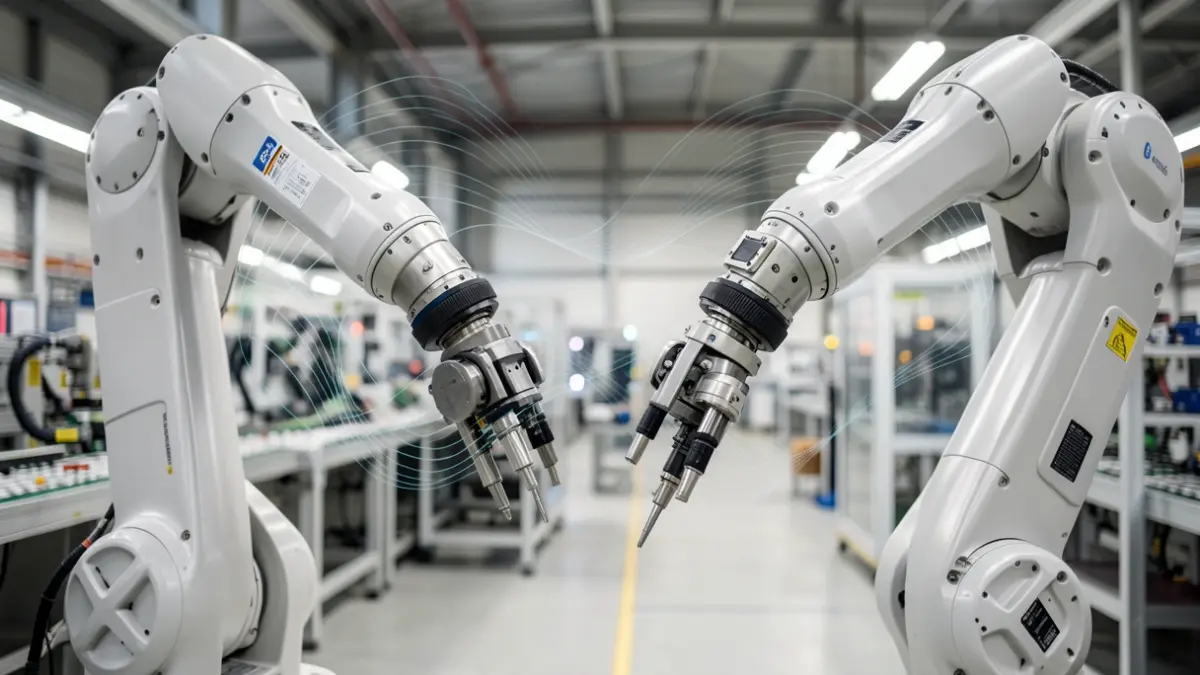

The consortium aims to eliminate the dependence on heavy cables in industry, which hinder plant reorganization. The new 6G wireless network will offer cable-like reliability but wirelessly, with latency below 15 milliseconds, allowing robots and autonomous vehicles to work in coordination and adapt production lines instantly to manufacture customised products.
The technology will be tested in two practical scenarios. The first, AURORA, led by Siemens AG, will allow vehicles and robots to negotiate tasks among themselves without a central computer. The second, SENTINEL, led by IMDEA Networks, will turn the communication signal into an invisible radar. By analysing radio wave reflections, the network will detect people and obstacles even in blind spots or low light, creating a digital twin with a precision of 20 to 30 centimetres.
“"With PRIME-6G we create an intelligent and punctual network that allows us to take flexible automation out of the laboratory and into real plants."
The UC3M team leads the setup of the '6G radar' at NEXTONIC, an open research laboratory in Leganés managed jointly by IMDEA Networks and Telefónica. After initial tests in Leganés and at Siemens facilities in Garching (Munich), the technology will be transferred to Stuttgart (Germany) to be integrated into the ARENA2036 research campus, which functions as a real factory at a research scale.
To extend the results, the project will launch an innovation challenge coordinated by ARENA2036, inviting companies and institutions to propose scenarios in robotics, drones, or intralogistics. Interested organisations can register via the project website, where details on format and schedule will be published soon.