Pourbaix diagrams are essential tools in electrochemistry for understanding how phase stability changes with potential and pH. Traditionally based on theoretical equations and experimental data, there has been a growing interest in predicting these diagrams using computational data, fueled by massive databases like the Materials Project.
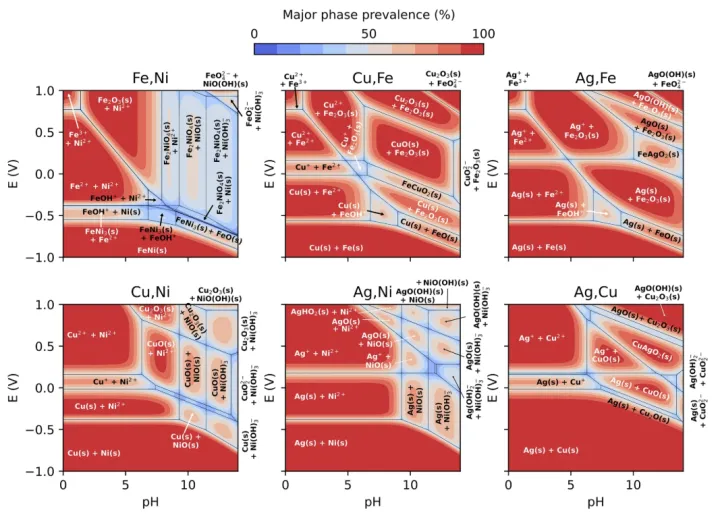
The new approach proposed by Diego Garay-Ruiz and Marisol Martín-González relies on calculating thermodynamic Boltzmann populations across pH and potential space, constructing 3D Pourbaix spaces. This allows for the introduction of competition-informed Pourbaix diagrams, where the representation of the major phase's prevalence reveals regions where multiple phases are nearly degenerate.
This methodology identifies conditions where phase assignments are ill-defined, as energy differences between phases fall within the standard error range of density functional theory (DFT), providing thermodynamic confidence in assigning dominant phases. Furthermore, the study proposes additional analyses to better characterize competitive phases and simplify the comparison of Pourbaix diagrams across systems.
The PourbaixUP tool, implemented as open-source software, enables effective and detailed analysis of binary, ternary, and higher-order systems. The researchers have demonstrated its utility through several examples, including binary metal combinations, passivation and corrosion windows in Fe/Cr alloys, and chalcogenide materials of interest in thermoelectricity.