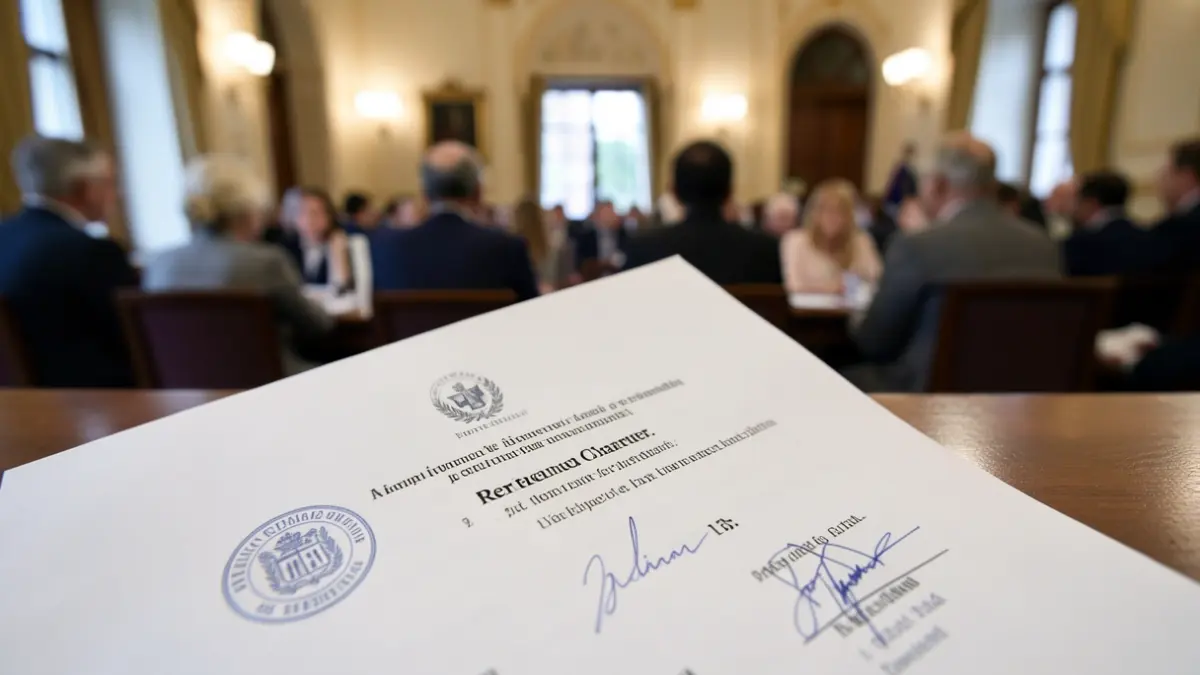
The Ibero-American Cultural Charter has been renewed twenty years after its original approval. This update responds to the need to adapt the common framework to the profound social, cultural, economic, technological, and environmental transformations experienced by Ibero-America in the last two decades. The process stemmed from the mandate of the XXII Ibero-American Conference of Ministers of Culture, held in Barcelona in September 2025.
The Ibero-American General Secretariat (SEGIB), the Organization of Ibero-American States for Education, Science and Culture (OEI), and the Ministry of Culture of Spain, as Pro Tempore Secretariat, coordinated an extensive review and participation process during 2026. This process allowed for the updating and expansion of the commitments contained in the document originally approved in 2006.
Spain's Minister of Culture, Ernest Urtasun, highlighted that the update “places cultural rights at the center of public policies, strengthening cultural and linguistic diversity, inclusion, and equitable access to culture.” He added that for Spain, the renewed Charter also represents an opportunity to strengthen cultural cooperation between Europe and Ibero-America.
For his part, Ibero-American Secretary General, Andrés Allamand, stated that “culture is the soul and engine of Ibero-America. Updating our Cultural Charter allows us to project our diversity and talent towards the future, ensuring that technological innovation and sustainable development always place people and creators at the center.” Mariano Jabonero, Secretary General of the OEI, affirmed that the renewal is “magnificent news for our region and a demonstration of the enormous value of the cooperation and dialogue that Ibero-America is capable of building.”
The updated Charter reaffirms culture as a fundamental right, an essential public good, and a decisive factor for democracy, peace, social cohesion, and sustainable development. It renews the political will of the countries to continue building, from diversity and cooperation, a strengthened, inclusive Ibero-American Cultural Space prepared to face the challenges of the 21st century.
Among the main novelties, cultural rights are consolidated as the axis of public policies, and cultural democracy, citizen participation, and equitable access to cultural life are strengthened. Commitments related to gender equality, inclusion, accessibility, and non-discrimination are also expanded, and the cultural, linguistic, and biocultural diversity of Ibero-America is explicitly recognized from an intercultural perspective.
A significant advance is the incorporation of challenges related to digital transformation. The Charter pays special attention to the exercise of cultural and author rights in digital environments and promotes an ethical use of emerging technologies, including artificial intelligence, given their growing impact on creation, production, access, and participation in cultural life.
The update also strengthens the consideration of cultural and creative ecosystems, recognizes the role of artists, creators, and cultural workers, and underscores the importance of ensuring adequate conditions for their development and sustainability. Greater relevance is given to the relationship between culture, environmental sustainability, and climate action, as well as to the protection of cultural heritage.
This update process is the result of an extensive participatory dialogue developed during 2026, involving Ibero-American States, specialists, civil society representatives, cultural communities, indigenous and Afro-descendant peoples, creators, and academic representatives. Online sessions and a seminar in Montevideo were also included.
The Ibero-American Cultural Charter was originally approved in 2006 at the XVI Ibero-American Summit in Montevideo, Uruguay. It has served as a common framework for recognizing the value of culture, promoting diversity, strengthening public policies, and fostering cooperation among Ibero-American countries.