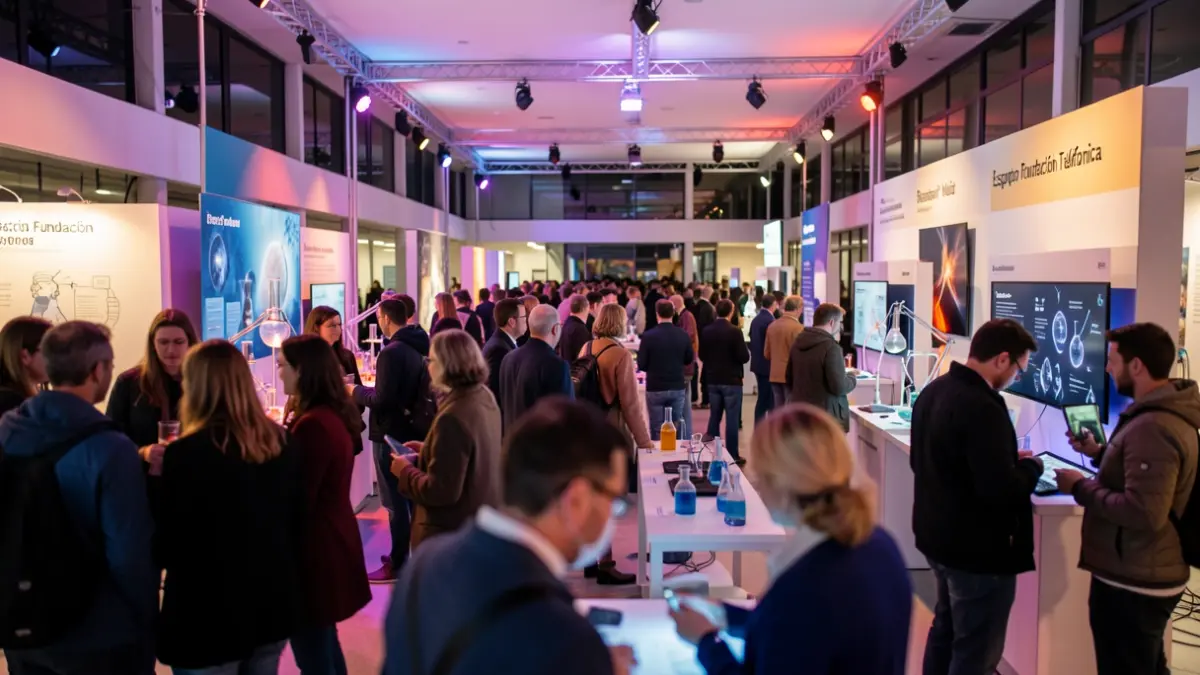
Once again, the CNB-CSIC was part of the European Researchers' Night, an event aimed at bridging the gap between the scientific community and the general public. This year's edition, held at the Fundación Telefónica Space in Madrid, saw around 40 volunteer staff from the center contribute to the dissemination of scientific knowledge through various activities.
The fair, jointly organized by 11 centers of the Spanish National Research Council (CSIC) in Madrid, featured proposals from diverse scientific disciplines. The CNB presented outreach activities designed for all ages, where its researchers shared their work and expertise.
The program also included a space in the auditorium of the Fundación Telefónica Space, where attendees enjoyed cultural offerings such as the short play Eclipsadas, focusing on women in science; the pop-rock concert Biolocas, with lyrics about biology; and the play Doro, about the chemist Dorotea Barnés. A researcher from the CNB hosted the afternoon program, and the play Eclipsadas, written and performed by researchers from the center, premiered at this edition.
Eclipsadas tells the stories of three women scientists whose research was crucial for scientific advancement, but whose recognition was attributed to others, thus reclaiming the scientific careers of women throughout history.
At the science fair booths, visitors explored aspects of microorganisms like viruses and bacteria, learned about reconstructing three-dimensional molecular structures using cryo-electron microscopy images, and discovered how the immune system produces different antibodies to specifically defend against various pathogens. Additionally, workshops such as 'The Green Allies of Biotechnology,' on plant species used in molecular, cellular, and genetic research, and 'Protect Your Cells from the Sun,' on cellular damage from ultraviolet radiation, were offered.
The involvement of nearly 40 CNB volunteers was key to the success of the event, which attracted over 1,500 people. The center expressed gratitude to all volunteers for their dedication in preparing activities and sharing their knowledge. The collaboration with 10 other CSIC centers amplified the impact of the outreach efforts.
This joint science fair, coordinated by the Institute of Materials Science of Madrid (ICMM), also included participation from the Institute of Catalysis and Petrochemistry (ICP), the National Center for Biotechnology (CNB), the Institute of Food Science Research (CIAL), the Institute of Ceramics and Glass (ICV), the Institute of Mathematical Sciences (ICMAT), the Institute of Theoretical Physics (IFT), the Institute of Micro and Nanotechnology (IMN), the Center for Molecular Biology (CBM), the Sols-Morreale Institute for Biomedical Research (IIBM), and the Geological and Mining Institute of Spain (IGME).