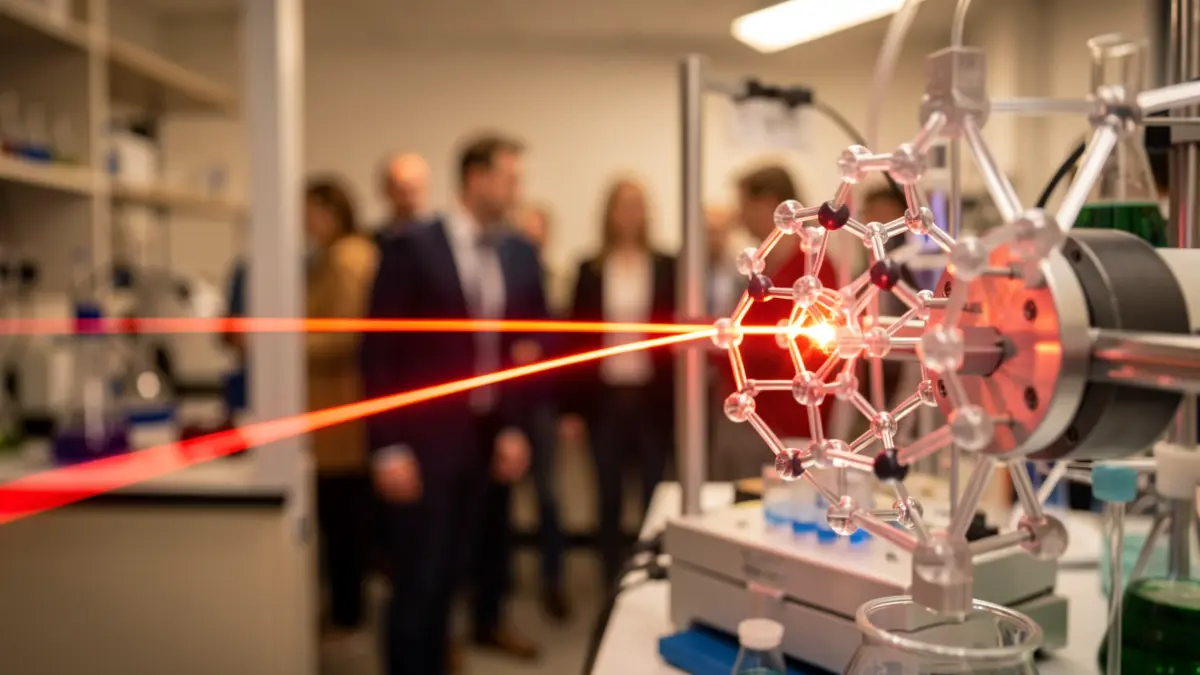
The TOMATTO project (The ultimate Time scale in Organic Molecular opto-electronics, the ATTOsecond), led by Nazario Martín (Complutense University), Fernando Martín (Autonomous University of Madrid), and Mauro Nisoli (Politecnico di Milano), aims to optimize photovoltaic cell efficiency using attosecond technology. The film documenting this initiative, titled "Light with Time Inside" and produced by the Madrid Institute for Advanced Studies in Nanoscience (IMDEA Nanociencia), has won the award at the ceremony held in A Coruña.
The film, directed by Luis Gómez-Juanes, takes viewers on a journey of the researchers between Milan and Madrid, showcasing experimental facilities, computational tools, and the collaborative work essential for studying electron dynamics at extremely short timescales. The jury highlighted the documentary's ability to "make an enormously complex physical phenomenon accessible and exciting without neglecting the human side of scientific research."
Filming took place at key locations including the Attosecond Laboratory at Politecnico di Milano, the Faculty of Chemical Sciences at Complutense University of Madrid, the Supercomputing Center at the Autonomous University of Madrid, and the facilities of IMDEA Nanociencia.
The documentary will have its world premiere at the Science and Technology Film Festival in Krakow (Poland), competing among over 1,000 entries.
The TOMATTO project, funded by an ERC Synergy Grant from the European Research Council and supported by the Community of Madrid, focuses on the attosecond timescale (10-18 seconds). The goal is to understand and manipulate electron movement to improve electrical conductivity.