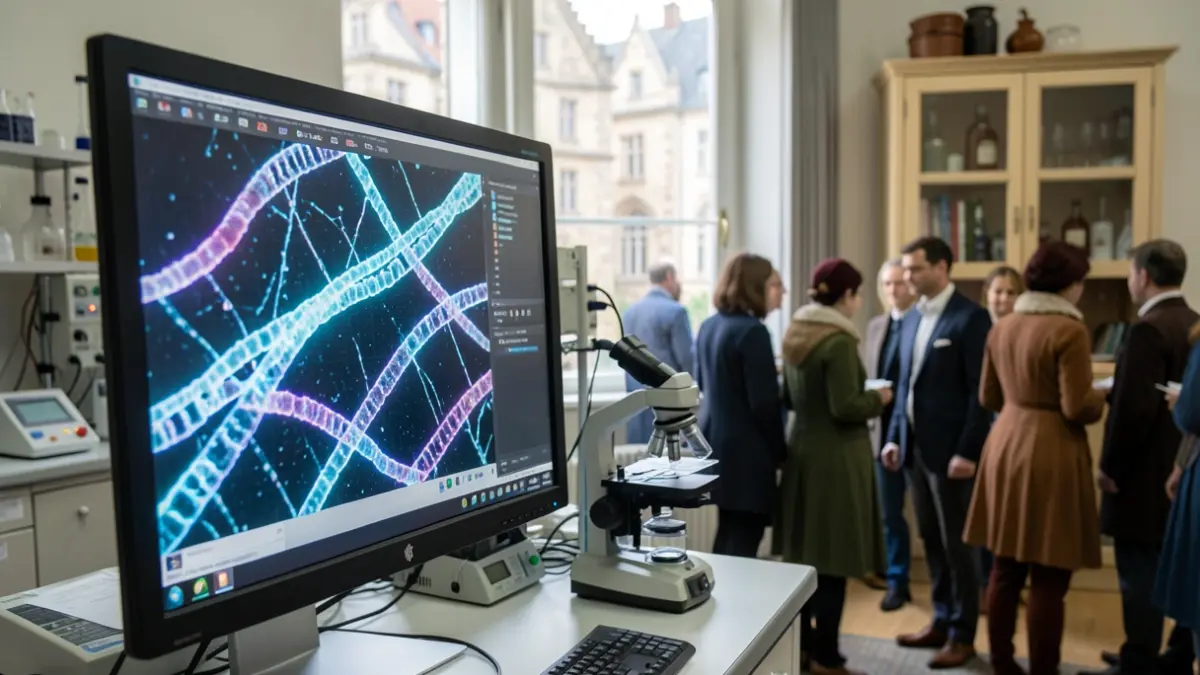
A study published in the journal Genealogy, led by teams from the Autonomous University of Madrid (UAM) and the Complutense University of Madrid (UCM), identified four maternal lineages (mitochondrial DNA) in five individuals buried at the site. Notably, one lineage is linked to the Horn of Africa, suggesting greater diversity of origins than previously thought.
The research combines archaeology, anthropology, and genetics. One of the most significant findings is the mitochondrial DNA of a young man buried in a sarcophagus, belonging to haplogroup L3h2, a lineage rarely documented in Western Europe and more prevalent today in the Horn of Africa. This finding points to African ancestry, although his ancestors might have settled in the Iberian Peninsula generations earlier.
The study also analyzed the DNA of another adult male in the same sarcophagus, who presented haplogroup H2a2, of Eurasian distribution. A third adult individual in a different sarcophagus showed lineage T1a, associated with populations from Central and Northeastern Europe. These results nuance traditional historiographical interpretations of migratory movements and the formation of the Visigothic Kingdom, suggesting a complex process of mobility and integration rather than a generalized demographic replacement.
The analysis also examined kinship between the two individuals buried in tomb 4. Their different mitochondrial lineages rule out a shared direct maternal line, emphasizing that a shared burial does not necessarily imply close kinship. The two individuals who died around birth shared haplogroup HV0, linked to long-standing ancestry in the Iberian Peninsula.
Compared with genetic data from 132 individuals from the Iberian Peninsula and Europe, the study detected affinities with other sites, challenging the image of isolated rural communities and supporting the persistence of local populations that incorporated new ancestries. The authors note that the scope of the conclusions is limited by the small sample size and the exclusive analysis of mitochondrial DNA.
The research was funded by the Directorate General for Cultural Heritage of the Community of Madrid, the UAM, the Ayuntamiento de El Boalo, Cerceda y Mataelpino, and the Palarq Foundation. The bibliographic reference is: R Javier Salido-Domínguez et al. «Beyond Isolation: Mitochondrial Variability and Micro-Regional Discontinuity at El Rebollar (Madrid, 7th Century CE)». Genealogy, 10(4), 148 (2026).