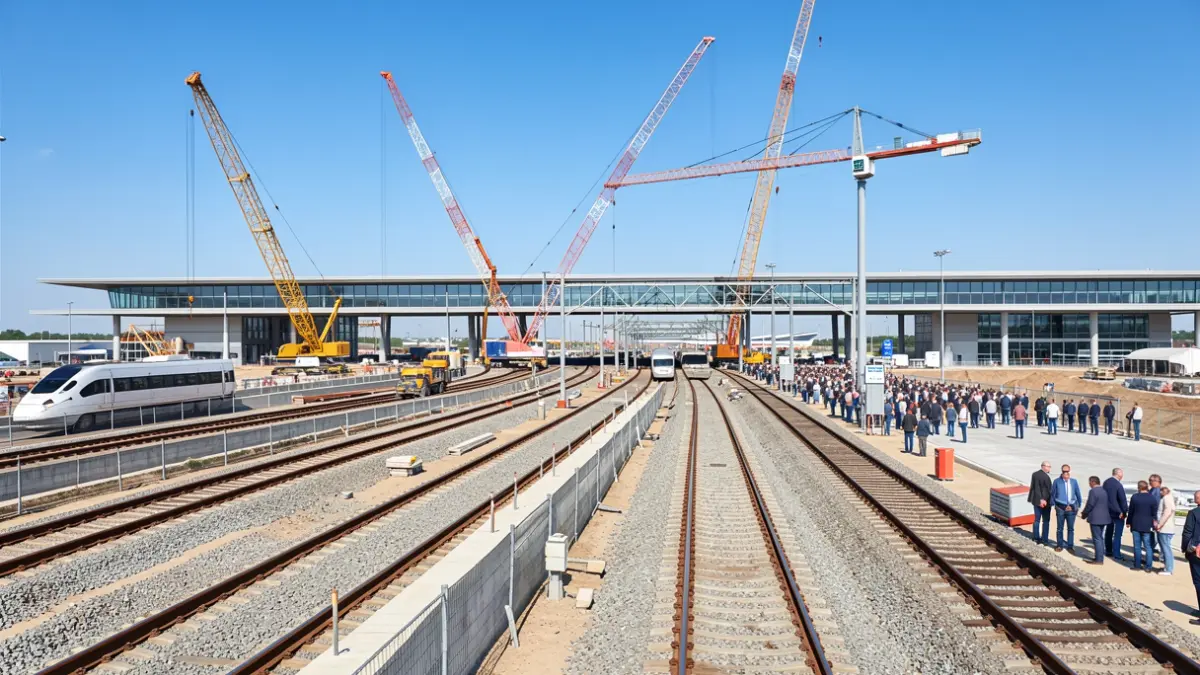
This strategic infrastructure aims to enhance intermodality and significantly improve rail connectivity with Spain's main airport. The new standard gauge route already has its platform completed, including walls, a new underpass, and reinforcement of a Cercanías tunnel.
The relocation of affected services, the laying of sub-ballast and ballast, and track assembly have been completed. Simultaneously, electrification works are progressing, with catenary pole installation executed on approximately 60% of the new route, along with the installation of channels and cabling for control and signaling systems.
The direct connection will facilitate passenger travel and better integrate Madrid-Barajas Airport into the high-speed network, consolidating Chamartín-Clara Campoamor as a key transport hub in the capital. Highly complex works have been carried out in the vicinity of the Hortaleza technical station to adapt the infrastructure for future high-speed operation.
In this area, the configuration of standard gauge tracks has been reconfigured, and slab track has been renewed to implement a three-rail system, allowing trains of different gauges to circulate. New crossings, mixed-gauge turnouts, and electrification gantries have been installed, along with updated safety and communication systems.
A new under-track passage for drivers has been constructed at the Hortaleza technical station, and all works have been carried out while keeping the Cercanías service operational. In the coming months, leveling, profiling, and welding of the double track will be completed, along with the installation of catenaries and the overhead contact line.
Adif will subsequently address the software loading for the high-speed interlocking system, the installation of safety and communication equipment, and the installation of the new connection switch, all crucial steps for the commissioning of the new railway link to the airport.